Most apps test words. We teach them.
Knowing a word isn't one thing — it's four. Can your child spell it? Do they know what it means? Do they know its opposite? Can they use it in a sentence? Vocab 360 builds all four dimensions of every word, unlocking each layer only when the previous one is solid.
Start free with spelling practice and word lookup.
Every Prac2XL account includes free spelling practice for your child's weekly school list plus instant word lookup — definitions, synonyms, antonyms, and example sentences on demand. Add the words on Monday. Your child practises all week. Friday email tells you they're ready.
When you see how well structured practice and word lookup work together, imagine what happens across 1,350 words — with full mastery tracking, adaptive difficulty, and real sentence usage. That's Vocab 360.
School Spelling List
Weekly words, adaptive difficulty, parent stats, Friday report
Full Vocabulary Depth
1,350+ words × 4 dimensions × 3 difficulties. Mastery tracking. Word graduation.
Four dimensions of every word. Real depth, not flashcard guessing.
Most vocabulary apps show a word, show a definition, and call it done. Your child recognises the word for a day and forgets it by next week. That's not learning — that's exposure.
Vocab 360 builds genuine understanding through four progressive dimensions. Each dimension unlocks only when the previous one is solid. Your child can't move to synonyms until they can spell the word. Can't move to antonyms until they understand its meaning. Can't use it in context until they understand its nuances.
Within each session, practice is interleaved — spelling one word, then a synonym for another, then a sentence for a third. Your child never drills the same word or dimension repeatedly. The mix keeps the brain active and builds stronger retention.
✏️ Spelling
Can they write it?Multiple choice, fill-in-the-blanks, error correction, and full word spelling. Audio pronunciation for every word. Building from recognition to recall — the same progressive challenge as our maths system.
🔗 Synonyms
What does it mean?Matching, multiple choice, and context-based synonym selection. Your child doesn’t just memorise a definition — they understand what the word means by connecting it to words they already know.
⚡ Antonyms
What’s the opposite?Understanding opposites deepens comprehension. Your child learns to distinguish between similar concepts — essential for verbal reasoning and precise communication.
📝 Use in Sentences
Can they use it?Sentence completion and usage in real context. 38,700+ unique sentence templates with age-appropriate scenarios. The ultimate test — can your child use this word naturally and correctly?
Progressive unlock. Each dimension unlocks only when the previous one is solid. Your child builds genuine depth — not surface-level familiarity. A word isn't "learned" until all four dimensions are strong.
The more your child masters, the more they unlock.
Word Pool Expansion
Every 5 words your child masters in spelling, 5 new words unlock. Start with core curriculum words and grow into extended vocabulary. The system grows with your child — no fixed schedule, no artificial limits.
Word Graduation
When all four dimensions of a word reach a strong level, that word graduates. Your child builds a growing collection of fully-learned words — a visible achievement they can be proud of.
Audio Pronunciation
Every word has clear British English audio pronunciation. Your child hears the word, then spells it. Essential for EAL learners and any child who learns better by listening.
Mastery Stages
Each dimension of each word is tracked through Learner → Confident → Achiever → Master. Clear progress goals across every word, every dimension.
Real screenshots. Real progress.
What your child sees — and what you see. Every day.
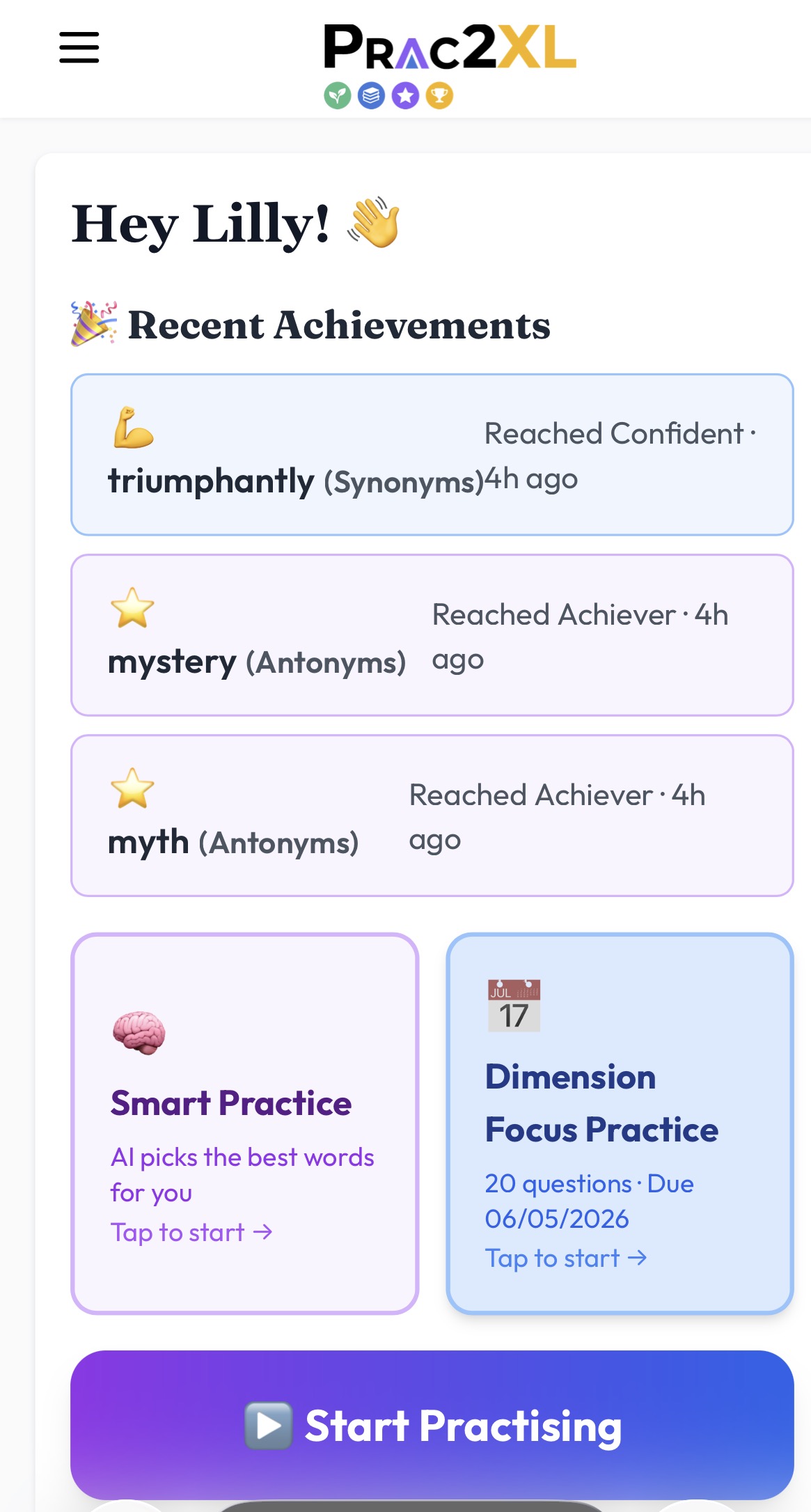
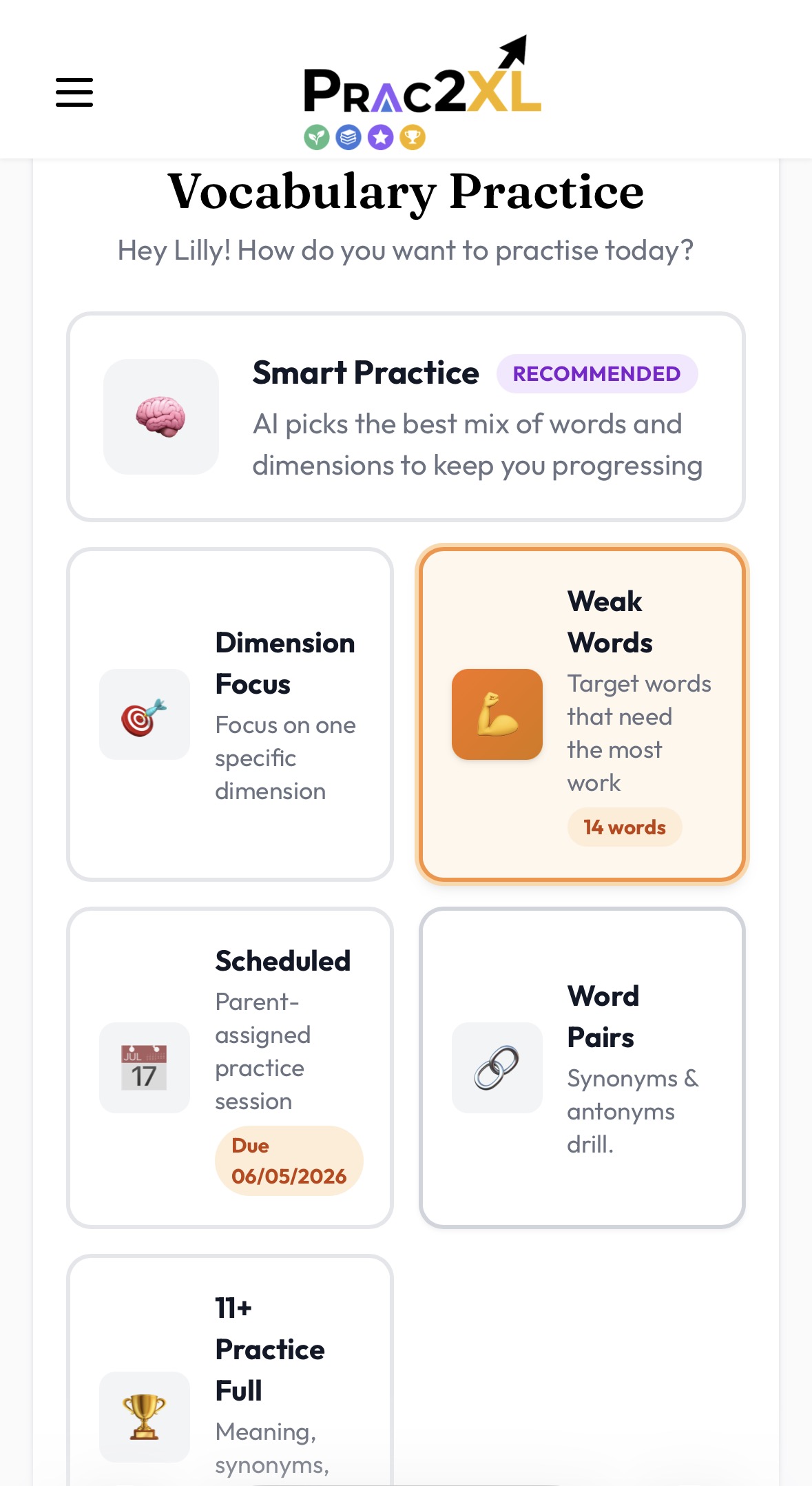
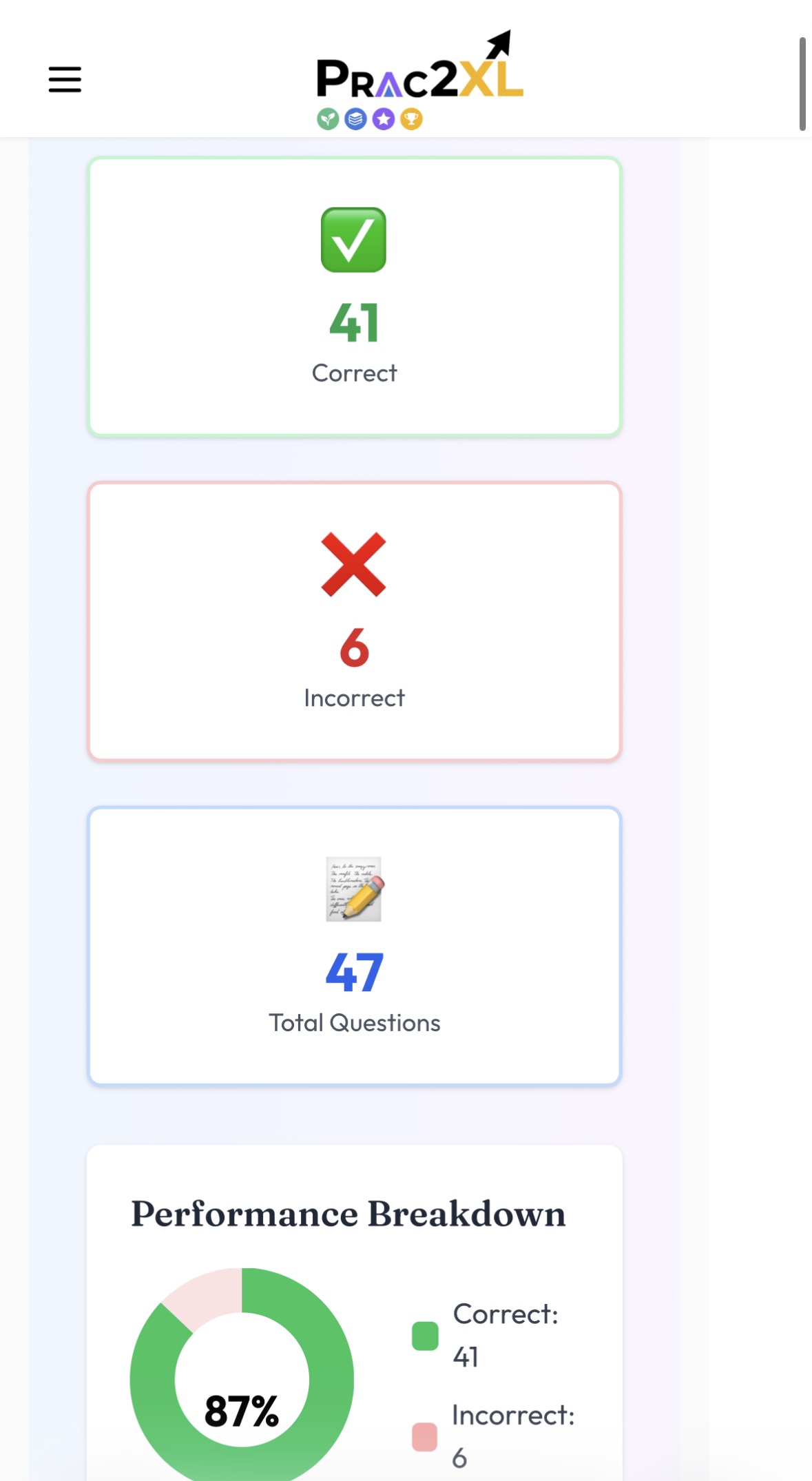
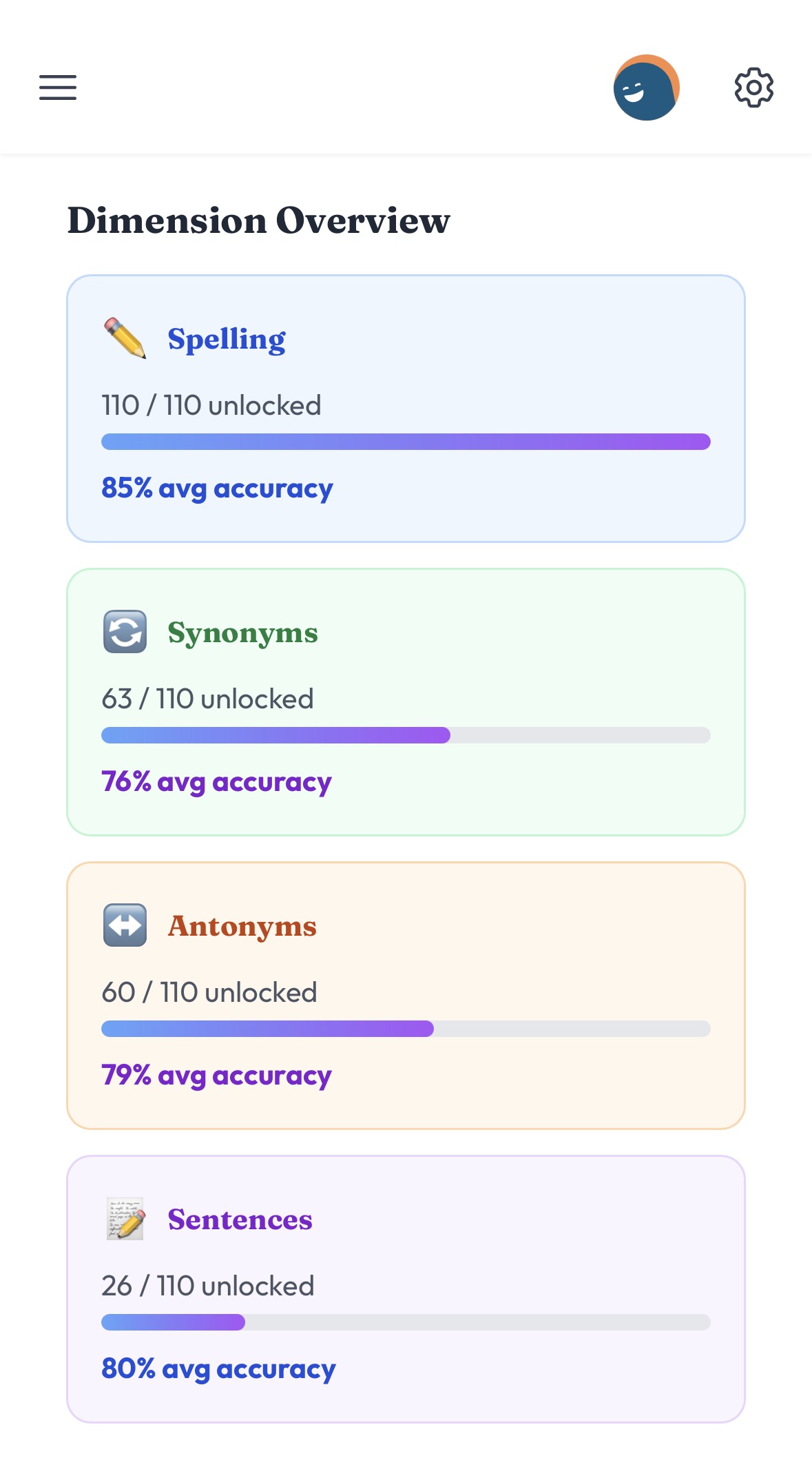
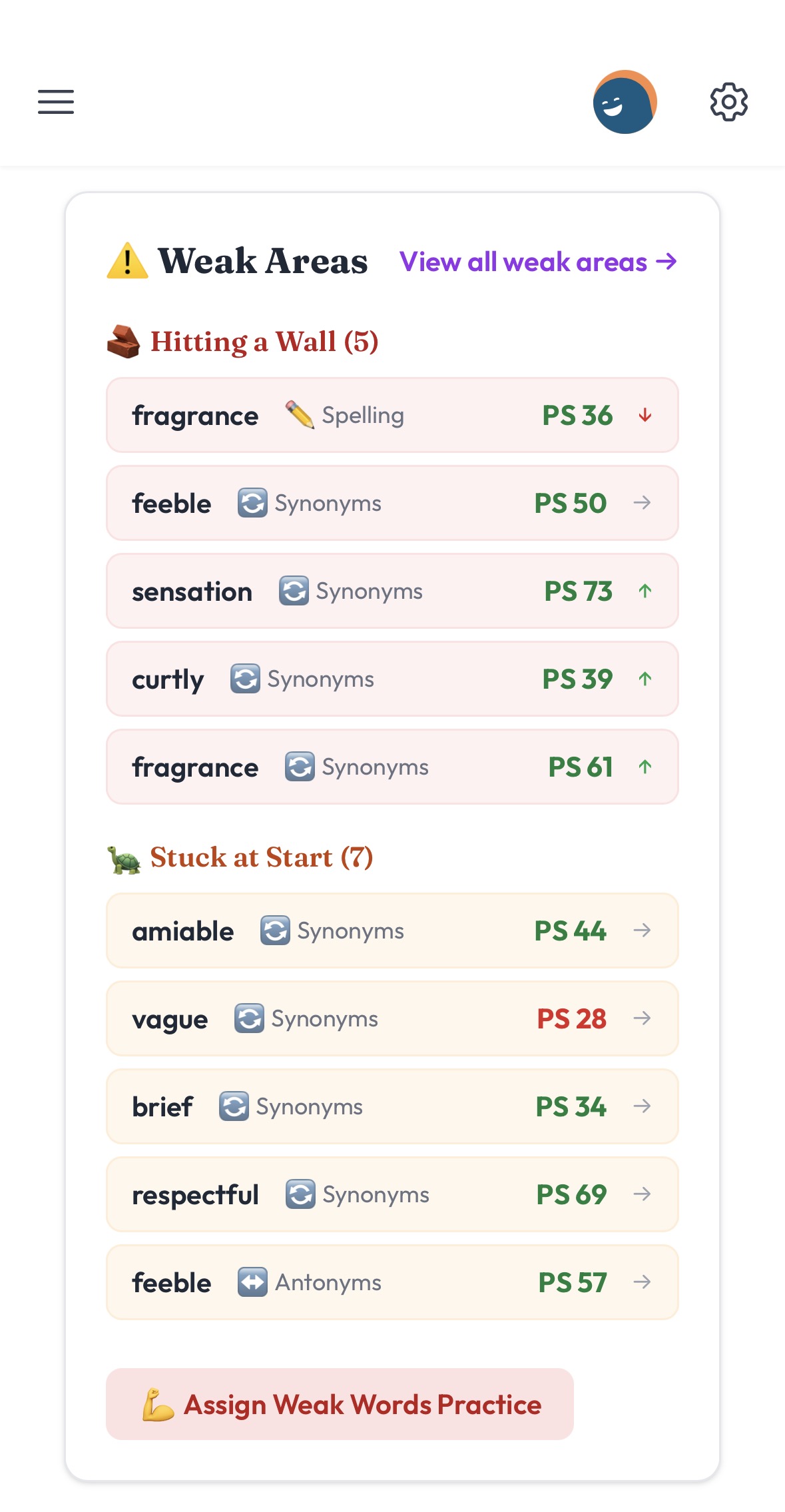
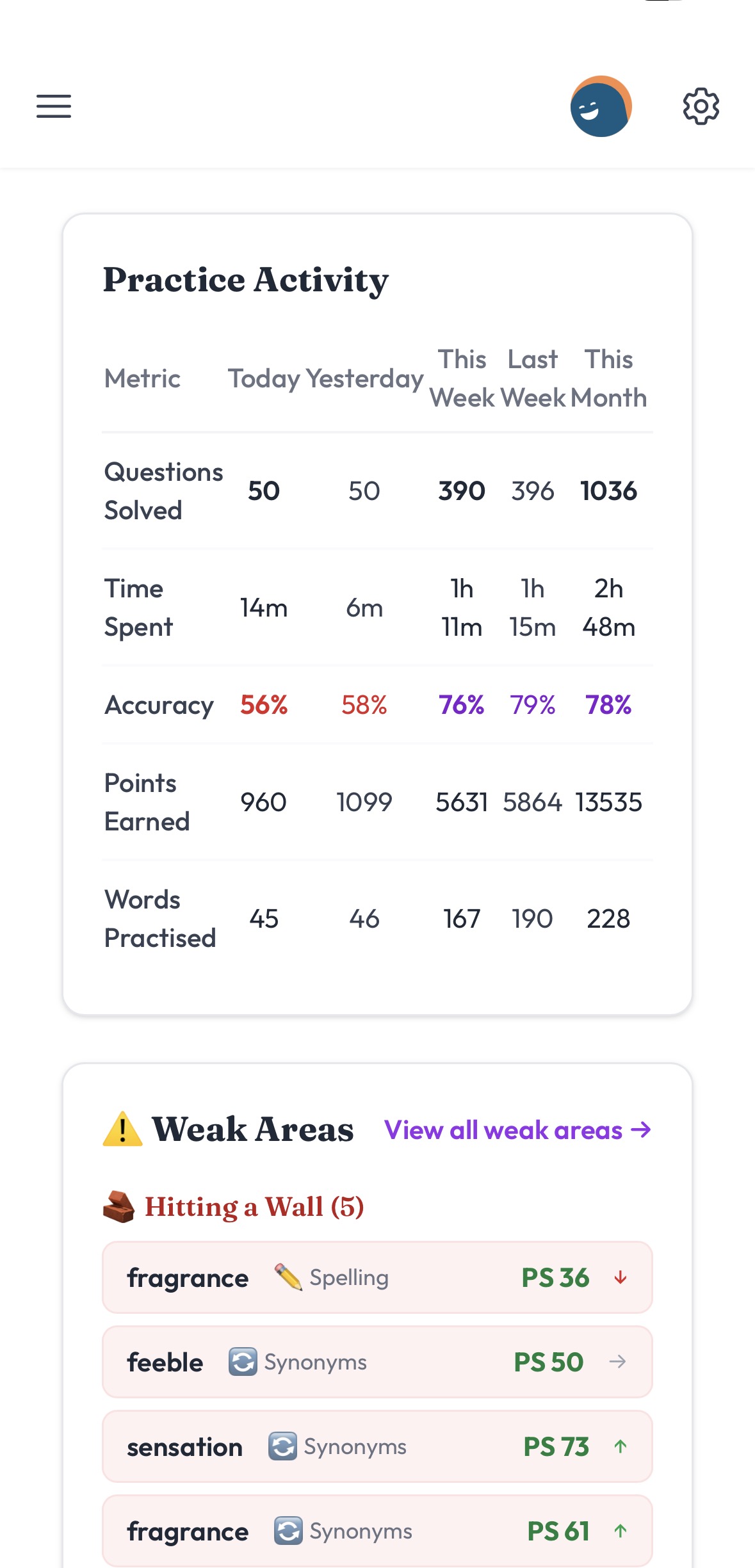
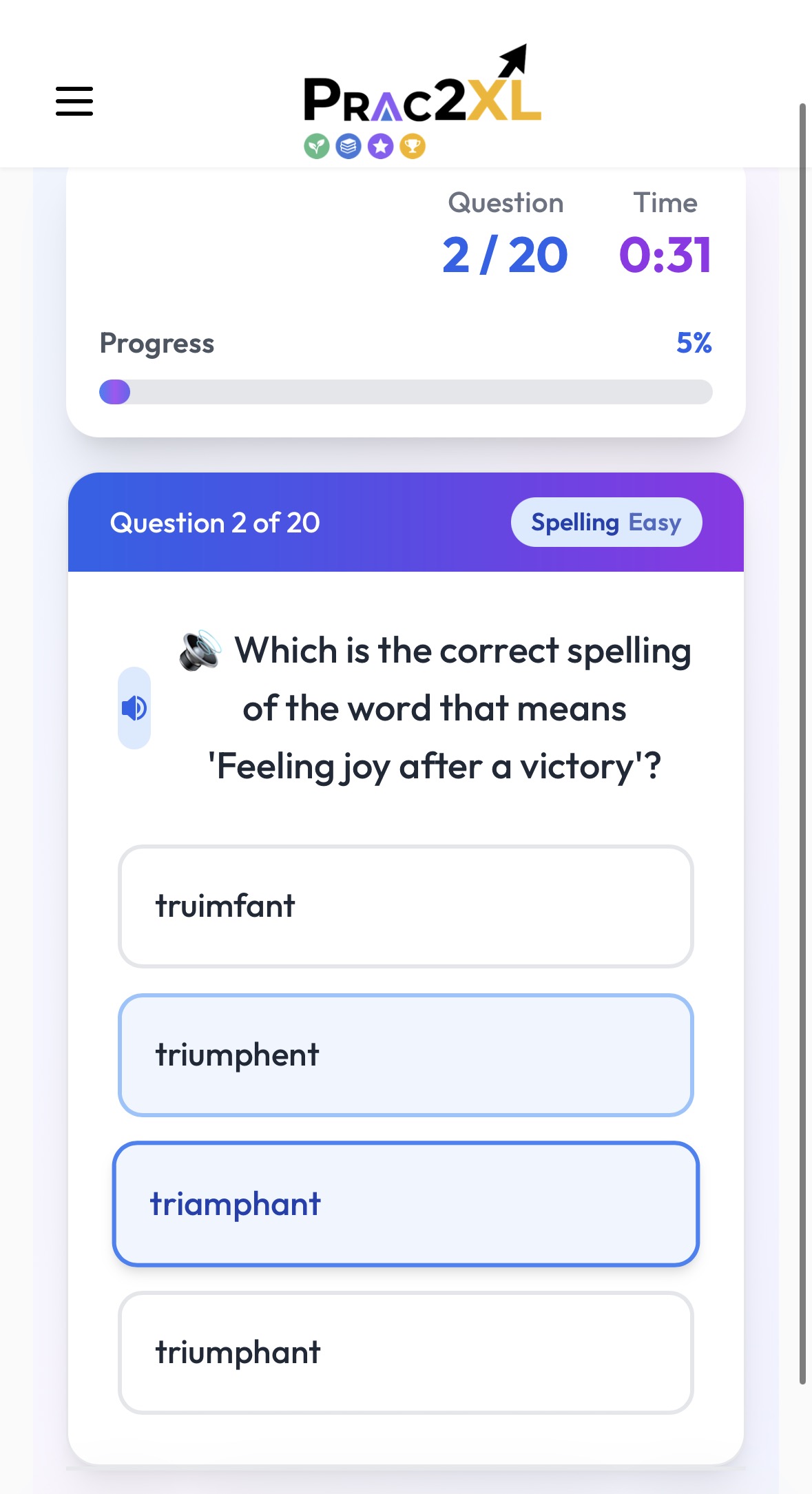
Your child’s vocabulary hub — pick a mode and start
You can't cram vocabulary. It compounds.
Every 11+ prep company will sell you practice papers in Year 5. But here's what those papers expose: if your child doesn't know the words, no amount of technique helps.
A synonym question asks: "Which word is closest in meaning to RELUCTANT?" If your child has never encountered "reluctant," they guess. If they learned it in Year 3, practised its synonym ("unwilling") and antonym ("eager"), and used it in sentences for two years — they answer in three seconds and move on.
Vocabulary isn't like maths methods. You can teach column addition in a week. You can't teach 1,000 words in a week. Each word needs to be spelled, understood, connected to synonyms and antonyms, and used in context. That's four dimensions, built over time. That's Vocab 360.
300+ words — spelling foundations
Your child learns to spell core words correctly. Common exception words. Everyday vocabulary. The base that everything builds on. Spelling unlocks synonyms.
700+ words — meaning deepens
Synonyms and antonyms unlock. "Happy" connects to "elated," "delighted," "cheerful." "Miserable" becomes its opposite. Words form networks, not isolated definitions. Reading comprehension improves because your child actually understands the words in the passage.
1,000+ words — ready for anything
11+ verbal reasoning tests the vocabulary your child has been building for three years. Synonyms, antonyms, word-in-context, analogies — these aren't new skills. They're skills practised across hundreds of words. Other children are cramming word lists. Yours already knows the words.
1,350+ words — deep, lasting knowledge
SATs SPaG paper. Secondary school readiness. Creative writing with precise vocabulary. Comprehension passages with advanced words. Four years of depth means your child doesn't just pass — they excel.
The difference between cramming and compounding: A child who starts vocabulary practice in Year 5 learns 200 words under pressure. A child who started in Year 2 has known 1,000+ words for years — deeply, across four dimensions. The 11+ paper is the same. The preparation couldn't be more different.
A dedicated mode for 11+ verbal reasoning.
The 11+ verbal reasoning paper tests two things: does your child know what a word means, and do they know its opposite? Prac2XL's 11+ mode focuses entirely on synonyms and antonyms — the exact skills the exam demands — with optional timed practice.
Synonyms and antonyms only
Your child practises the two skills the 11+ actually tests. No spelling drills. No sentence completion. Focused, efficient, exam-relevant practice every session.
2,500+ words
Starting with core curriculum words your child already encounters at school, then building to advanced vocabulary that appears on 11+ papers. The system introduces new words as your child is ready.
Timed practice
Toggle on a per-question countdown: 30 seconds for easy, 20 for medium, 15 for hard. The 11+ is time-pressured — practice should be too.
New words unlock as confidence grows
As your child demonstrates confidence with each word’s synonyms and antonyms, new words are introduced automatically. They’re always working at the right level of challenge.
Works alongside full Vocab 360
11+ practice isn’t wasted. Switch to full Vocab 360 and every word your child has mastered carries over — with spelling and sentence dimensions ready to start.
Your child starts practising synonyms
Synonym confidence grows → Antonyms unlock
Both strong → New word introduced
The cycle repeats — always growing
Vocabulary is the foundation for everything.
Reading comprehension. Writing quality. Verbal reasoning. SATs. 11+. Every academic skill depends on the words your child knows — and how deeply they know them.
Reading Comprehension
Children who know more words understand more of what they read. Vocabulary is the single strongest predictor of reading success.
Writing Quality
Better vocabulary means more precise, more varied, more engaging writing. It's the difference between "good" and "exceptional" in every assessment.
11+ Verbal Reasoning
Synonyms, antonyms, analogies — the core of verbal reasoning papers. Prac2XL includes a dedicated 11+ mode that drills exactly these skills with timed practice across 2,500+ words. Children who've built this depth over years arrive ready, not guessing.
Stuck on a word? PracTutor teaches it — not just defines it.
PracTutor doesn't just tell your child what a word means. It explains why, gives examples, and helps them understand the nuances.
🔤 Spelling help
“You spelled ‘because’ as ‘becuse’ — you’re close! Try breaking it into chunks: be-cause. The ‘cause’ part is like the word ‘cause’ on its own.”
🔗 Synonym guidance
“‘Big’ and ‘enormous’ are related, but ‘enormous’ means much bigger. A dog is big. A whale is enormous. Which answer means really, really large?”
📝 Sentence coaching
“You put ‘happy’ in that sentence, but ‘delighted’ works better here because the character just won a prize — that’s a stronger feeling than just happy!”
You chose 'big' as a synonym for 'enormous.' They're related — but 'enormous' means much bigger than just 'big.' Think of it this way: a dog is big, but a whale is enormous. Which answer means something really, really large?
Is it huge?
Yes! 'Huge' is a great synonym for 'enormous' — they both mean something that's really, really big. Well done! 🎉 Can you think of something enormous you've seen?
Safe by design. PracTutor discusses vocabulary only. It cannot access the internet or respond to off-topic questions. All conversations are visible in your parent dashboard.
Other Apps vs Vocab 360
| Feature | Other Apps | Vocab 360 ✶ |
|---|---|---|
| Approach | Spell the word, see the definition | 4 dimensions: spelling, meaning, opposites, sentences |
| Depth | Surface recognition | Can they spell it, understand it, and use it? |
| Retention | Practised this week, forgotten next | Interleaved across words and dimensions, plus spaced repetition over months |
| Difficulty | Same format for every word | Easy → Medium → Hard per dimension, adapting to your child |
| Tracking | Tested / Not tested | 4 dimensions × mastery stages per word |
| Context | Isolated word lists | 38,700+ sentence templates with real-world context |
| Audio | Sometimes available | British English pronunciation for every word |
| Personalisation | Same list for everyone | Weak words get more practice automatically |
| 11+ Verbal Prep | Buy separate practice papers | Dedicated 11+ mode: 2,500+ words, synonym/antonym focus, timed practice |
| Curriculum | Varies by platform | UK National Curriculum aligned, Years 2–6 |
| When Stuck | Show answer and move on | PracTutor teaches why, not just what |
| School Lists | Some support them | Free spelling practice with 9,000+ pre-loaded words, audio, and smart misspellings |
Simple, transparent pricing
Four dimensions of every word. Adaptive difficulty. PracTutor included. Free spelling practice always available.
- All 4 dimensions of practice
- 1,350+ words, Years 2–6
- 38,700+ sentence templates
- PracTutor AI vocabulary tutor
- Audio pronunciation for every word
- Parent dashboard
- PracPoints & streaks
- Free school spelling list included
- Everything in Individual
- Up to 4 child profiles
- Combined dashboard
- Individual progress tracking
- School spelling lists per child
Four dimensions of every word — every day.
🎓 Not ready to pay? Every account includes free spelling list practice. Start free →
Also from Prac2XL: Adaptive Maths
Already subscribed to Vocab 360? Add Maths at 50% off — just £2.50/month per child.
Words your child knows deeply today
become the language they use confidently tomorrow.
Start free with school spelling practice and word lookup. Upgrade to Vocab 360 when you're ready for the full four-dimension curriculum.
Free spelling — no card required · Vocab 360 from £4.99/month